


Meditation has been practiced for thousands of years without smartwatches, heart rate monitors, or any form of technology. Progress was traditionally measured through direct experience: a calmer mind, greater emotional balance, improved concentration and a deeper sense of presence in daily life.
Today, wearable devices like the Apple Watch allow meditators to observe something previous generations could only feel. Heart rate tracking provides a unique window into how the body responds during meditation and how different practices influence the nervous system.
Naturally, this raises an interesting question: can your heart rate reveal anything meaningful about the quality of your meditation?
The answer is yes — but probably not in the way most people expect.
Heart rate can provide valuable insight into relaxation, recovery and nervous system regulation. However, it should never be viewed as a score or a measurement of spiritual progress. Like meditation itself, the real value comes from observing patterns rather than chasing specific numbers.
Why Heart Rate Changes During Meditation
Even when you’re sitting completely still, your body is constantly reacting to what’s happening in your mind. Stressful thoughts, anticipation, anxiety, excitement and emotional reactions all influence the nervous system. Your heart responds not only to physical activity but also to mental activity.
This is why your pulse may rise while worrying about tomorrow’s meeting or replaying an uncomfortable conversation from earlier in the day. Nothing is happening externally, yet the body behaves as though it needs to prepare for action.
Meditation often interrupts this cycle. As attention settles into the present moment and breathing becomes more natural, the nervous system gradually shifts away from stress and toward balance. Muscles begin to relax, breathing becomes smoother and many practitioners notice that their heart rate starts to settle as well.
Not everyone experiences dramatic changes and that’s perfectly normal. Age, fitness level, sleep quality, caffeine intake, stress levels and overall health all influence heart rate. This is why comparing your numbers to someone else’s is rarely useful. The most meaningful comparison is always with your own previous sessions.
Why Lower Doesn’t Always Mean Better
One of the most common misconceptions about meditation tracking is the belief that a lower heart rate automatically means a deeper meditation.
In reality, things are more complicated.
Imagine two meditation sessions. In the first session, a practitioner’s heart rate drops to 45 BPM, but their attention repeatedly drifts into daydreams and moments of drowsiness. In the second session, another meditator never goes below 52 BPM, yet remains fully present and attentive throughout the entire practice.
Which meditation was deeper?
Most experienced meditation teachers would likely argue that the second session represents a stronger practice. The reason is simple: meditation is not merely relaxation—it is relaxed awareness.
A low heart rate can tell us that the body is calm, but it cannot tell us whether the mind is present.
Someone can be physically relaxed while remaining completely lost in thought. At the same time, another practitioner may be alert, focused and deeply engaged in the meditation process without producing an exceptionally low heart rate.
This is why individual numbers should always be interpreted within the broader context of the session.
The Signal Most People Overlook: Stability
If there is one heart rate pattern that deserves more attention, it is stability.
Most people finish a meditation session and immediately look for the lowest number on the graph. While that number can be interesting, it often misses the bigger story. What matters just as much—if not more—is how the heart behaved throughout the session.
When the mind constantly jumps between thoughts, plans, worries and memories, the body often reflects that activity. Heart rate tends to fluctuate more dramatically. As concentration deepens and awareness becomes steadier, many practitioners notice something different: their heart rate begins to settle into a narrower range.
The goal isn’t a perfectly flat line. Human beings aren’t machines. Instead, the body develops a more consistent rhythm. Breathing becomes natural, attention feels less scattered and distractions lose some of their power.
Consider two heart rate graphs. One reaches an impressive low of 45 BPM but fluctuates between 45 and 65 throughout the session. The other never drops below 52 BPM yet remains stable between 52 and 55 for twenty minutes. While both sessions may be beneficial, many experienced meditators would view the second pattern as a stronger sign of nervous system regulation and sustained presence.
In this sense, heart rate stability may reveal more about the quality of a meditation session than the lowest number reached.
The Role of Breathing
The relationship between breathing and heart rate has been recognized by meditation traditions for centuries. Nearly every meditation practice includes some connection to the breath, whether practitioners actively focus on it or simply observe it.
When we’re stressed, breathing often becomes shallow and irregular. When we’re calm, breathing naturally slows and deepens. The heart responds to these changes, which is one reason breath awareness remains one of the most effective meditation techniques available.
As breathing becomes smoother and more relaxed, many practitioners notice corresponding changes in heart rate. Importantly, this process should not be forced. Trying to control every breath often creates tension rather than relaxation. Instead, experienced meditators simply maintain awareness and allow breathing to settle naturally.
Over time, the body learns how to enter a calmer state more efficiently and heart rate patterns frequently reflect this shift.
Using Heart Rate as Feedback
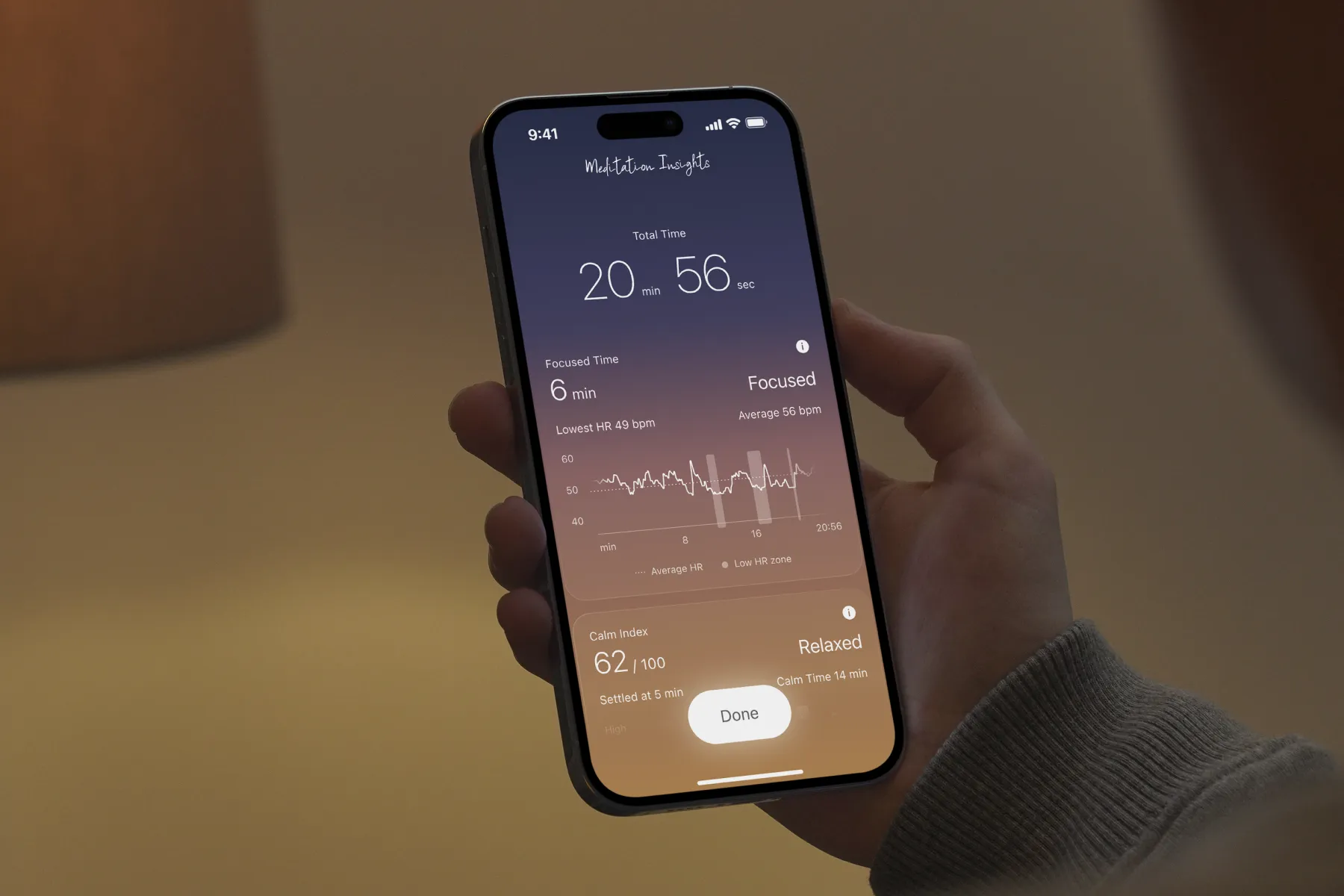
Modern technology gives meditators access to information that would have been impossible to observe only a decade ago. Reviewing heart rate patterns after meditation can help identify trends, compare techniques and better understand how the body responds to different practices.
One of the most interesting discoveries for many meditators is that their subjective experience doesn’t always match the data. A session that felt calm and effortless may reveal frequent heart rate fluctuations, while another session that felt ordinary may show long periods of remarkable stability.
This is where tracking becomes valuable. Instead of judging a meditation based on memory alone, you can observe how your body responded throughout the session.
In Rise: Meditation Timer App, you can review your heart rate minute by minute after each session and identify patterns that are difficult to notice in real time. Many users are surprised to discover that some of their “best” meditations feel very different from what the heart rate data reveals. Over time, these insights help build a deeper understanding of focus, relaxation and consistency.
Beyond the Numbers
While heart rate can provide valuable insight, it remains only one piece of a much larger picture.
No graph can measure compassion. No device can measure wisdom. No metric can fully capture awareness.
The most meaningful signs of progress often appear outside formal meditation sessions. You may notice that you’re less reactive during stressful situations, more patient with other people, or able to focus more easily throughout the day. You may find yourself recovering more quickly from difficult emotions or becoming less controlled by habitual thought patterns.
These changes are often far more significant than any number displayed on a screen.
Heart rate data can illuminate part of the journey, but it should never replace the journey itself.
FAQ: Heart Rate & Meditation
There is no single “ideal” heart rate during meditation. Your age, fitness level, stress levels, sleep quality and meditation experience all influence your heart rate. The most useful comparison is how your own heart rate changes over time rather than comparing your numbers to someone else’s.
No. A lower heart rate often reflects physical relaxation, but it does not automatically indicate mindfulness, concentration or awareness. A person can be sleepy and have a very low heart rate, while another practitioner may remain highly focused with a slightly higher pulse.
Heart rate naturally responds to thoughts, emotions, breathing patterns, and nervous system activity. Some fluctuation is completely normal. Over time, many meditators notice greater heart rate stability as their practice becomes more consistent.
Regular meditation may support a healthier nervous system and reduce chronic stress, which can contribute to a lower resting heart rate over time. However, results vary from person to person and depend on many lifestyle factors.
Most practitioners benefit more from reviewing heart rate after a session rather than watching it in real time. Constantly checking metrics can become a distraction from the meditation itself.
Yes. Apple Watch continuously measures heart rate and can provide useful insights when paired with meditation tracking apps such as Rise Meditaiton Timer.
For many meditators, stability can be more meaningful than the lowest heart rate reached during a session. A consistent heart rate pattern may reflect sustained focus, relaxation, and nervous system regulation.
Final Thoughts
Thousands of meditation sessions have already been tracked in Rise Meditation App, helping practitioners better understand the connection between awareness, breathing and heart rate patterns.
Heart rate cannot tell you everything about your meditation. But it can tell you something. It can reveal how your nervous system responds to stress, how breathing influences your body and how consistent practice shapes your physiological state over time.
Most importantly, it can encourage curiosity.
Meditation has always been a practice of self-awareness. Technology simply provides another lens through which to observe that process. The numbers are not the destination — they are signposts along the path.
If you’re interested in exploring meditation more deeply, connecting with experienced practitioners or discovering meditation experiences in Sedona, visit:
Follow Us


.avif)
.webp)